Showing posts with label Virginia. Show all posts

Thursday, August 6, 2015

Four new National Historic Landmarks designated


WASHINGTON, August 4, 2015 – Secretary of the Interior Sally Jewell and National Park Service Director Jonathan B. Jarvis today announced the designation of four new national historic landmarks.  The designation recognizes the sites as places that possess exceptional value and quality in illustrating or interpreting the heritage of the United States.

“Though very different from one another, these places reflect the creatively and ingenuity of the American spirit,” said National Park Service Director Jonathan B. Jarvis. “National historic landmarks are an example of how the mission of the National Park Service extends beyond park boundaries to recognize additional places of national significance in communities throughout the country."

The four national historic landmarks announced today are:
  • First Peoples Buffalo Jump, Cascade County, Mont.
Photo: stateparks.mt.gov
First Peoples Buffalo Jump is one of the oldest, largest, and best preserved bison cliff jump locations in North America.  Its monumental record of stone surface architecture, deeply stratified bison bone deposits, multiple tipi ring concentrations, and extensive evidence of ceremonies indicate that, for approximately 5,700 years, First Peoples Buffalo Jump held the paramount position in the Northern Plains “bison culture.”  This site holds the potential for defining the evolving sophistication of mass-procurement strategies of hunter-gatherer societies in the Northern Plains, and may also provide insights regarding cultural development of Precontact hunter-gatherer societies in the western United States.
  • George Washington Masonic National Memorial, Alexandria, Va.
Photo: gwmemorial.org
The George Washington Masonic National Memorial stands among the most architecturally significant projects to honor George Washington and one of the boldest private efforts to memorialize him. The Grand Lodges of the states and territories, which usually operate independently, joined forces to build this national memorial. This eclectic building combines neoclassical architecture common to American memorials and civic buildings with a modern skyscraper design.
  • Lafayette Park, Detroit, Mich.
Photo: nps.gov
Lafayette Park is one of the earliest planned and most fully-realized urban renewal projects of the mid-twentieth century.  It succeeded in creating an ethnically-diverse community that continues to thrive today and is generally regarded as one of the best and most successful examples of a residential urban renewal development in the nation.  It was a collaborative design endeavor between architect (Ludwig Mies van der Rohe), developer (Herbert Greenwald), planner (Ludwig Hilberseimer), and landscape architect (Alfred Caldwell).
  • Red Rocks Park and Mount Morrison Civilian Conservation Corps Camp, Jefferson County, Colo.
Photo: nps.gov
The outstanding architecture and landscape architecture of Red Rocks Park and Mount Morrison Civilian Conservation Corps Camp illustrate the principles and practices of New Deal-era naturalistic park design and master planning in a metropolitan park as well as the use of Civilian Conservation Corps (CCC) labor to develop such a park. Mount Morrison CCC Camp is one of the few surviving camps in the nation that retains a high concentration of original resources. The amphitheater in the park is one of America’s best known performing arts venues, famous for its natural acoustics, design, and setting.

Wednesday, April 1, 2015

Appomattox Court House National Historical Park, Virginia

This month's National Park Getaway

By Jim Godburn, park ranger, Appomattox Court House National Historical Park

NOTE: Five days of 150th anniversary (click for schedule) commemorative events are planned from April 8 to April 12, 2015, at Appomattox Court House to mark the end of America's Civil War. 

Photo: NPS Image of "The Surrender"
by contemporary artist Keith Rocco


Appomattox – the name echoes through history, beckoning people worldwide to this historic village nestled in the quiet Virginia countryside.

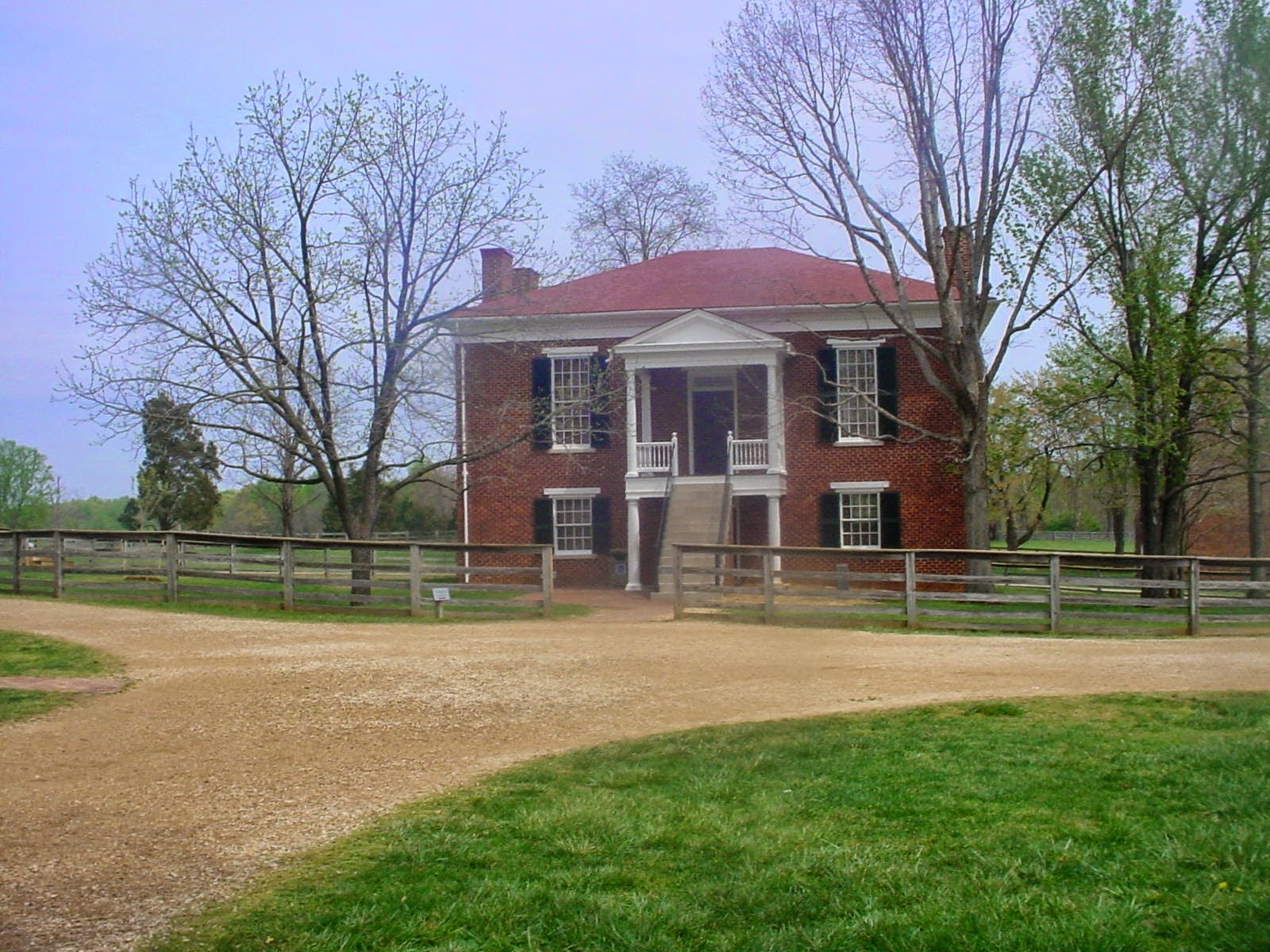
Stroll into the village and stop at the court house, a re-creation of the building that was the 19th-century seat of government in Appomattox County and today serves as the park's visitor center. There, you can talk with a ranger and find park brochures. Head to the second floor to tour the museum and view a short film in the theater.

NPS Photo of Appomattox County Court House
Just a two-hour drive west from Richmond, Virginia, Appomattox Court House is the site where Robert E. Lee surrendered Confederate forces to the Federal command of Ulysses S. Grant. The surrender, on April 9, 1865, ushered in the final days of the American Civil War as well as the first, halting footsteps of the journey toward citizenship for former slaves.

At the court house, join one of the scheduled talks, presented daily from May through October. You'll hear about military events and village life from a 21st century perspective from a uniformed ranger. Gain a 19th century perspective from staff or volunteers outfitted in attire of the 1860s: you might meet a soldier, a former slave, a doctor, or a citizen of the village. For these characters, the year is always 1865.

You can tour the village at your own pace. Visit a lawyer's office, county jail, general store, and tavern to get a feeling for 19th century village life. At Clover Hill Tavern, the neighborhood's oldest building, you'll learn how 30,000 paroles were printed and distributed to surrendering Confederate soldiers. A small bookstore is located in the kitchen building behind the tavern.


Appomattox Court House is open 360 days a year, from 8:30 a.m. to 5:00 p.m.

Read more here.
 

Friday, July 15, 2011

Park Service to commemorate 150th anniversary of First Battle of Manassas

The National Park Service will commemorate the sesquicentennial of the Battle of First Manassas with events at the Virginia park from Thursday, July 21 through Sunday, July 24, 2011.

The four-day observance of the 150th anniversary of the First Battle of Manassas begins with a commemorative ceremony at the Henry Hill Visitor Center on Thursday, July 21 at 9:15 a.m. This program, sponsored by the National Park Service and the Virginia Sesquicentennial of the American Civil War Commission, will examine both the profound impact of the battle, as well as the broader Civil War, and the rich opportunities afforded by the anniversary.
Invited speakers include Robert F. McDonnell, Governor of Virginia, National Park Service Director Jon Jarvis, and other local, state, and federal officials. The keynote address will be given by Dr. Edward L. Ayers, president of the University of Richmond and historian of the American South. Free tickets are available for the July 21 commemorative ceremony.  Free tickets are available at the Henry Hill Visitor Center (6511 Sudley Road).

Interpretive programs including tours and living history demonstrations will be presented throughout the four-day event. On Friday evening, July 22 at 6 p.m. park rangers will present a program "Behind the Lines – War Passes Sudley Springs." The program will depart from Sudley United Methodist Church (5308 Sudley Road).  On Saturday, July 23 at 2 p.m. starting at the Henry Hill Visitor Center rangers will present "The Robinson Farm – An African American Family Caught in the Crossfire."  A complete schedule of programs including small arms and artillery demonstrations is available at the park web site, http://www.nps.gov/mana/parknews/anniversary-schedule.htm.